This makes me really sad
Youth Suicides, Andrew Shirvell, and America’s Tolerance of Anti-LGBT Hate
I used to work as a substitute in my younger brother's school (Jr. High) and consequentially, my alma mater. I discovered that some of the boys he hangs out with would should "Hiland's Gay!" (his name, then gay), in the hallways or lunch room. My mother went in and talked to the principal who started to "crack down," but I don't think he made much of an impression on those boys.
In one of the classes I was teaching shortly after this occurence, one student asked my opinion of gay marriage, I told him my opinion, and then he told me "I think it's gross," and he continued to tell me other homophobic opinions of his. I told him off, and my tactic, was to tell him "Kids kill themselves every year because of homophobic comments and bullying like that. Kill themselves. I don't tolerate that sort of language or attitude," (or something very similar). I think that kids should be aware that homophobic attitudes (bullying) cause suicide, and that no matter how not serious they think their comments are, they are serious.
But here's my big question, why are more teachers not opposing these comments? My 8th Grade health teacher ("Coach," she thought other titles made her old...), was the first person to ever in my life present to me the opposing viewpoint that being gay was not a bad or, god forbid, gross thing. She made a speech on one of the first days telling us how she would not tolerate any homophobia in her classroom. I can honestly say, that it was this defining moment that changed my attitudes. It was seriously that simple. It was obvious to me she had a point, and all it took was one person to convince me. Why did it take until the 8th grade for me to hear this? And why do I think nothing has changed.
Thursday, September 30, 2010

Monday, September 27, 2010
Community Activism, and Reflexive Scholarship
There were a couple of points in the articles for this week that stood out to me. In the Khan article (Reconfiguring the Native Informant: Positionality in the Global Age), right in the beginning she identifies a "conundrum for women who critique the sexism in their communities -- they are silenced by the fear of being accused of betrayal by community members," and so they seek sexism elsewhere, often in the Third World. This also applies to others who feel that they must fight the fight elsewhere, often abroad. For me, this is a fresh way of viewing this movement. I had always thought that is was a lack of introspection and a feeling of superiority that drove us abroad to fight for social justice. It can be more challenging to fight injustice in our own communities, and even less rewarding, since we know what the real results are. But that is just the point. We know better than anyone what sort of solutions will work, and what are the things that really need to changed. It is hard to know the true depth of a problem, and try to fix it, rather than superficially know a problem and think that you fixed it. I appreciate Khan's perspective on this issue.
In the rather lengthy and wordy Kesby article (Retheorizing Empowerment-through-Participation as a Performance in Space: Beyond Tyranny to Transformation), I found his definitions of power really intriguing. It really falls right into the feminist methodologies. It reminds me of the idea of contextualizing subjects and topics, and now contextualizing power. His whole focus on how people are constantly performing really made me think of my research project for my BA in Sociology. It was all about Symbolic Interactionism and Impression Management, and the more I thought about my methodology and my actual paper, I started to realize the subtle but unmistakable Guerilla 'Gogy that my professor had been enacting! First off, he made us write a "Person-Problem Statement" which is basically how you are connected to this research as a person. Wait! Reflexivity, woah. Second, he suggested I try an experiment methodology, which is rather nontraditional of sociology. I had made these heinous (well at least I subjectively tried) shoes, and asked people to wear them around for a day then tell me about their experience. They wrote about how they did not think they would be self-conscious, but how slowly they realized how they were becoming more paranoid and trying to hide the shoes. To me, this is on the way to being a participatory project, since my subjects were in on the basic tenets of my project and themselves went through this process that was my research -- trying to convince the reader that shoes matter! While it was far from perfect (hey, it was only my second year), thinking about it now, I am amazed at what happened. Also, reading my person-problem statement and thinking about that whole process makes me amazed at that tricky professor of mine.
A picture of the Ug(ly) Shoes


In the rather lengthy and wordy Kesby article (Retheorizing Empowerment-through-Participation as a Performance in Space: Beyond Tyranny to Transformation), I found his definitions of power really intriguing. It really falls right into the feminist methodologies. It reminds me of the idea of contextualizing subjects and topics, and now contextualizing power. His whole focus on how people are constantly performing really made me think of my research project for my BA in Sociology. It was all about Symbolic Interactionism and Impression Management, and the more I thought about my methodology and my actual paper, I started to realize the subtle but unmistakable Guerilla 'Gogy that my professor had been enacting! First off, he made us write a "Person-Problem Statement" which is basically how you are connected to this research as a person. Wait! Reflexivity, woah. Second, he suggested I try an experiment methodology, which is rather nontraditional of sociology. I had made these heinous (well at least I subjectively tried) shoes, and asked people to wear them around for a day then tell me about their experience. They wrote about how they did not think they would be self-conscious, but how slowly they realized how they were becoming more paranoid and trying to hide the shoes. To me, this is on the way to being a participatory project, since my subjects were in on the basic tenets of my project and themselves went through this process that was my research -- trying to convince the reader that shoes matter! While it was far from perfect (hey, it was only my second year), thinking about it now, I am amazed at what happened. Also, reading my person-problem statement and thinking about that whole process makes me amazed at that tricky professor of mine.
A picture of the Ug(ly) Shoes


Friday, September 24, 2010
Justice not Equality
I've decided to post weekly aha moments (for myself) from our weekly classes. While my classmates who are probably the only ones reading this blog, I apologize for the redundancies, but I see this as also a record for myself -- a place to look back and reflect on my development. It will mostly be comprised of quotes, and as a result of my poor recording skills, they will probably be neither entirely accurate (think paraphrased) nor accurately cited (but if you recognize your quote, please comment and take claim!). Also, disclaimer: I realize by using the terms "man" and "woman" in my post I erase the existence of those who identify on the spectrum of gender, or who do not identify with a gender, but for the purpose of the conversation, I must operationalize the definition of gender as defined by our culture at large.
This week I posed the question of why as a movement, feminists are not necessarily advocating for equal spaces, but instead aim create spaces that seemed biased towards women. To myself feminist creation of spaces made sense, but I could honestly not vocalize the reasoning. My biggest "aha" moment was that it is about justice not equality (Megan and Prof. Ng). The idea of equality in the feminist movement was created by 2nd Wave feminists, which is when a lot of legislation was put forth like the Equal Pay Act and Title IX, and so the movement became framed as advocating for equality, and no longer for justice. What we want IS social justice (Megan). Creating spaces specifically for women is the feminist response to our patriarchal culture (Sam). When we can truly have equality then we will have reached a point where equal spaces can be created and succeed as such.
For those (often men) who feel left out or wronged by the feminist "response" to patriarchal institutions, it is important to realize that the oppressive forces acting on women are institutional (lack citation), and that institutionally women are oppressed. While feminists recognize that men also experience oppression through masculinity, within our patriarchal society they are the privileged population. For everyone to be institutionally oppressed, would mean no oppression (Prof. Ng), but this is not the case. Creating spaces for women places women in the picture, and without these spaces, we risk the danger of women being left out (Prof. Ng). To argue that feminists are not trying to create a world of equal chances, is to shift the discourse and become intransigent (lack citation). The problem feminists often face is that [as women] we are damned if we do, and damned if we don't -- the system is not set-up for us to succeed (Megan).
On another note, regarding researching "less privileged" (or those who we view to have less institutional power than ourselves) populations, it is about providing the means for empowerment instead of empowerment (Sara).
This is a link to that feministing article I referenced in class, and hopefully I make more sense now if you read it. If your thoughts are still the same let me know them in reference to the real post.
Also, if you find I have attributed something to you that you have no recollection of saying TELL ME! Thank you!

This week I posed the question of why as a movement, feminists are not necessarily advocating for equal spaces, but instead aim create spaces that seemed biased towards women. To myself feminist creation of spaces made sense, but I could honestly not vocalize the reasoning. My biggest "aha" moment was that it is about justice not equality (Megan and Prof. Ng). The idea of equality in the feminist movement was created by 2nd Wave feminists, which is when a lot of legislation was put forth like the Equal Pay Act and Title IX, and so the movement became framed as advocating for equality, and no longer for justice. What we want IS social justice (Megan). Creating spaces specifically for women is the feminist response to our patriarchal culture (Sam). When we can truly have equality then we will have reached a point where equal spaces can be created and succeed as such.
For those (often men) who feel left out or wronged by the feminist "response" to patriarchal institutions, it is important to realize that the oppressive forces acting on women are institutional (lack citation), and that institutionally women are oppressed. While feminists recognize that men also experience oppression through masculinity, within our patriarchal society they are the privileged population. For everyone to be institutionally oppressed, would mean no oppression (Prof. Ng), but this is not the case. Creating spaces for women places women in the picture, and without these spaces, we risk the danger of women being left out (Prof. Ng). To argue that feminists are not trying to create a world of equal chances, is to shift the discourse and become intransigent (lack citation). The problem feminists often face is that [as women] we are damned if we do, and damned if we don't -- the system is not set-up for us to succeed (Megan).
On another note, regarding researching "less privileged" (or those who we view to have less institutional power than ourselves) populations, it is about providing the means for empowerment instead of empowerment (Sara).
This is a link to that feministing article I referenced in class, and hopefully I make more sense now if you read it. If your thoughts are still the same let me know them in reference to the real post.
Also, if you find I have attributed something to you that you have no recollection of saying TELL ME! Thank you!

Thursday, September 23, 2010
This is pretty great.
Just thought I would re-post this video I came across. It intersects with Lady Gaga's opposition to Don't Ask Don't Tell. It's nice to see when people with power use their influence for good.
Monday, September 20, 2010
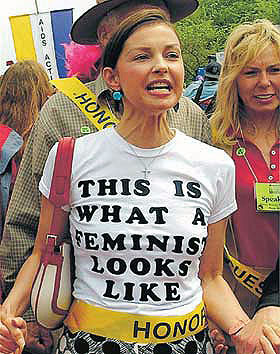
I'm not a feminist but...
In the reading by Linda McDowell, "Doing Gender: Feminists and Research Methods in Human Geography," she talks about some of the issues presented to feminist researchers. One of the topics she brushes upon is the reluctance to even present any body of work as innately feminist (pg. 403). This reminds me of the whole movement where we identify with feminist ideals, but are too afraid to identify as a feminist.

In high school I had these two friends who would not shave, wanted to be scientists, and were essentially the most liberal people I had ever met. Growing up in a conservative household (read, having a conservative father), I had never really thought about my opinion in political matters. Yet, after becoming politicized through college, I went back to my old friends, with my leftist views, and to my surprise they did not identify as feminists! How could this be, that I had already moved past (in my polarity) the people to originally corrupt my mind?! And yet, this was the case.
I find this very interesting, and I believe that part of this movement has to do with a successful conservative media campaign. To construct feminists as undesirable beings is in the favor of all those who wish to keep the system of benefiting men and oppressing women in place. It is really quite clever when you think of it. To create an identity around feminism, a movement that seeks to create equality between the sexes and provide opportunity to women, that discourages even women from identifying as a feminist is a pretty dean successful move. It can be astounding to have someone agree with me on most important feminist matters, and then get really defensive if I throw the F word out there.

So, do I think we need to rebrand feminism? Some would advocate for a changing of the name, but I say heck-no. Just like it is important to maintain Women's Studies as just that, and not revert to say "Gender Studies," it is important to maintain the central cause and history associated with feminism. I believe that creating these safe spaces for women and spaces for the correction of a patriarchal study is essential to creating equality.
What say you readers and classmates? Is creating exclusive spaces for the study and support of exclusively women reverse sexism or part of an equalizing cause? Should we stop referring to it as feminism when our main goal is to equalize both of the sexes? How are our "unequal" spaces creating equality? And should we just be creating equal spaces, such as a gender studies department, instead of maintaining women's studies (or even creating a men's studies)? I know my thoughts, but what are yours?

In high school I had these two friends who would not shave, wanted to be scientists, and were essentially the most liberal people I had ever met. Growing up in a conservative household (read, having a conservative father), I had never really thought about my opinion in political matters. Yet, after becoming politicized through college, I went back to my old friends, with my leftist views, and to my surprise they did not identify as feminists! How could this be, that I had already moved past (in my polarity) the people to originally corrupt my mind?! And yet, this was the case.
I find this very interesting, and I believe that part of this movement has to do with a successful conservative media campaign. To construct feminists as undesirable beings is in the favor of all those who wish to keep the system of benefiting men and oppressing women in place. It is really quite clever when you think of it. To create an identity around feminism, a movement that seeks to create equality between the sexes and provide opportunity to women, that discourages even women from identifying as a feminist is a pretty dean successful move. It can be astounding to have someone agree with me on most important feminist matters, and then get really defensive if I throw the F word out there.

So, do I think we need to rebrand feminism? Some would advocate for a changing of the name, but I say heck-no. Just like it is important to maintain Women's Studies as just that, and not revert to say "Gender Studies," it is important to maintain the central cause and history associated with feminism. I believe that creating these safe spaces for women and spaces for the correction of a patriarchal study is essential to creating equality.
What say you readers and classmates? Is creating exclusive spaces for the study and support of exclusively women reverse sexism or part of an equalizing cause? Should we stop referring to it as feminism when our main goal is to equalize both of the sexes? How are our "unequal" spaces creating equality? And should we just be creating equal spaces, such as a gender studies department, instead of maintaining women's studies (or even creating a men's studies)? I know my thoughts, but what are yours?

Monday, September 13, 2010
Reflections of an Imperialist
Grewal and Kaplan (Global Identities) discuss the idea of "transnationalism from below," and in another class my readings this week talked about Globalization from below.
In my Junior year of undergrad I took a class about the Dominican Republic, but it also mostly focused on grassroots organizing, imperialism, and globalization. It made me realize a LOT of things including concepts and theories, one being the idea of doing something from the bottom up. The idea of transnationalism or globalization from the bottom up, seeks to include the masses -- the people whose lives are most affected by such capitalist movements. It makes so much sense now that I know, but many never think about it. A movement from the bottom up seeks to make an inclusive movement that serves the needs of all who are involved. I think it is a fabulous concept that I would love to think more about in my classes.
Another concept I learned on this trip, is that of being a tourist from an imperialist country and the self-realization that comes with that. Grewal and Kaplan say that "Power differentials are always implicated in the activity of travel." When traveling to the DR with my class, we didn't do service work such as paint a house or teach children how to read, we actually learned, a lot, from grassroots movements that were already there. Last class we talked about taboo issues, one being how to address a topic when you are coming from a position of power. Traveling in non-western countries as a member from an imperialist country is one of those. When I went to the DR, and then especially to Nicaragua this past Spring, I was CONSTANTLY reflecting on my privilege as some one from the US.
The US really messed up both of these countries through our history of over-involvement, and they are in the state they are, (seemingly) almost exclusively from our involvement. How does one deal with that? Guilt doesn't bring me anywhere, just keeps me in circles. What are my actions? What sort of service do I bring? It's difficult to mediate your position within their society -- a society accustomed to the aid of foreigners, but also screwed over by the "aid" of foreigners. Even more difficult still is mediating this amongst other United Statesians (coincidentally you cannot be an American in Latin America, as they [we] are all Americans). When people would ask me if I built houses or how I helped the people, it is difficult to explain things such as the charity model and what I feel our involvement should really be. That is also why it is nice to know that organizations like Witness for Peace are out there. They are all about bringing Americans (from the USA) to locations like Nicaragua and giving them tours of places like Free Trade Zones, so that they can go back to the USA and organize there.
Why are we so eager to go to developing countries and give aid and support, but not willing to try to make the change from our own country first.
A suggested song - http://www.annefeeney.com/media/sound/Richmanshouse.mov
In my Junior year of undergrad I took a class about the Dominican Republic, but it also mostly focused on grassroots organizing, imperialism, and globalization. It made me realize a LOT of things including concepts and theories, one being the idea of doing something from the bottom up. The idea of transnationalism or globalization from the bottom up, seeks to include the masses -- the people whose lives are most affected by such capitalist movements. It makes so much sense now that I know, but many never think about it. A movement from the bottom up seeks to make an inclusive movement that serves the needs of all who are involved. I think it is a fabulous concept that I would love to think more about in my classes.
Another concept I learned on this trip, is that of being a tourist from an imperialist country and the self-realization that comes with that. Grewal and Kaplan say that "Power differentials are always implicated in the activity of travel." When traveling to the DR with my class, we didn't do service work such as paint a house or teach children how to read, we actually learned, a lot, from grassroots movements that were already there. Last class we talked about taboo issues, one being how to address a topic when you are coming from a position of power. Traveling in non-western countries as a member from an imperialist country is one of those. When I went to the DR, and then especially to Nicaragua this past Spring, I was CONSTANTLY reflecting on my privilege as some one from the US.
The US really messed up both of these countries through our history of over-involvement, and they are in the state they are, (seemingly) almost exclusively from our involvement. How does one deal with that? Guilt doesn't bring me anywhere, just keeps me in circles. What are my actions? What sort of service do I bring? It's difficult to mediate your position within their society -- a society accustomed to the aid of foreigners, but also screwed over by the "aid" of foreigners. Even more difficult still is mediating this amongst other United Statesians (coincidentally you cannot be an American in Latin America, as they [we] are all Americans). When people would ask me if I built houses or how I helped the people, it is difficult to explain things such as the charity model and what I feel our involvement should really be. That is also why it is nice to know that organizations like Witness for Peace are out there. They are all about bringing Americans (from the USA) to locations like Nicaragua and giving them tours of places like Free Trade Zones, so that they can go back to the USA and organize there.
Why are we so eager to go to developing countries and give aid and support, but not willing to try to make the change from our own country first.
A suggested song - http://www.annefeeney.com/media/sound/Richmanshouse.mov
Monday, September 6, 2010
Even as a professional, we can't be professionals
Both the Presser article and the article by Gwendolyn Beetham and Justina Demetriades (Feminist research methodologies and development: overview and practical application) discuss the relationship between the researcher and the subject, and how this intersects with feminism.
Despite out best efforts, we do influence the way our questions are asked, and even how they are answered. Presser talks about how the men she interviewed would constantly try to assert their masculinity or even dominance over her through flirtations, or pretending they would take care of her in some ways. As a woman, this is an intimidating topic to think about. As just a regular woman, I have to deal with patriarchy all the time, but within my own research? Directed at me? Now that's a drag. But as Beetham and Demetriades point out, we cannot ignore these facts, but instead must face them with methodologies that challenge the claimed "gender blind" mentality.
It is interesting to sort of research research methods, and start to deconstruct how and why they might be gender biased (generally towards men). I look forward to the class's thoughts on how some methods are implicitly sexist, and how we can combat these.
Despite out best efforts, we do influence the way our questions are asked, and even how they are answered. Presser talks about how the men she interviewed would constantly try to assert their masculinity or even dominance over her through flirtations, or pretending they would take care of her in some ways. As a woman, this is an intimidating topic to think about. As just a regular woman, I have to deal with patriarchy all the time, but within my own research? Directed at me? Now that's a drag. But as Beetham and Demetriades point out, we cannot ignore these facts, but instead must face them with methodologies that challenge the claimed "gender blind" mentality.
It is interesting to sort of research research methods, and start to deconstruct how and why they might be gender biased (generally towards men). I look forward to the class's thoughts on how some methods are implicitly sexist, and how we can combat these.
Suite Crime and Making a Choice
In my Intro to Soc class my freshman year of college, I remember my professor saying that while social forces may influence what we do, in the end we still make the choice. Being a delinquency specialist within the sociology field, he was specifically referring to crime. This concept was very forefront in my mind when Lois Presser, in her article "Negotiating Power and Narrative in Research: Implications for Feminist Methodology," mentioned how when she talked with men who had committed violent crimes they started to construct a reality to excuse their behavior. While it is entirely tragic that we punish those who have less power within our society, and then punish them again when they do wrong, in the end they did make the choice, and except for the few mentally ill, violence is largely understood to be bad. For example, when Dwight had to get high before he could go and shoot the rapist of his girlfriend's daughter. In this same intro class, we also watched a documentary on men who were tried and convicted as adults when they were still minors, and sentenced to life. The film really spoke to how as a society we have a failed penal system, and this article reflected some of the same themes.
When Presser discussed how "political and economic interests shape definitions of violence," in regards to our definitions of violence and crime, I again hearkened back to my intro professor who constantly railed against "suite crime," or crime committed in office suites, corporate crime. White collar crime hurts so many more people than petty crime. When someone robs a convenience store they get what, maybe $50, and maybe they hurt or kill one person. Bernie Madoff stole my father's retirement. My father has to work 5 more years of his life to regain what Madoff stole. Now my father is a plumber for a union, and his job is physically tough. He is already beginning to break as a 46 year old man, who can't kneel without wincing and who needs a steroid shot once a month in his hand to prevent crippling pain. Now, Madoff did this to many many more people than my father -- I'd say he stole many lives, and yet, what is his punishment? Will it ever be enough? Why do we let our perceptions of violence be so influenced by political and economic elite? Why are we so concerned with getting crime off the streets but not out of the elites?

When Presser discussed how "political and economic interests shape definitions of violence," in regards to our definitions of violence and crime, I again hearkened back to my intro professor who constantly railed against "suite crime," or crime committed in office suites, corporate crime. White collar crime hurts so many more people than petty crime. When someone robs a convenience store they get what, maybe $50, and maybe they hurt or kill one person. Bernie Madoff stole my father's retirement. My father has to work 5 more years of his life to regain what Madoff stole. Now my father is a plumber for a union, and his job is physically tough. He is already beginning to break as a 46 year old man, who can't kneel without wincing and who needs a steroid shot once a month in his hand to prevent crippling pain. Now, Madoff did this to many many more people than my father -- I'd say he stole many lives, and yet, what is his punishment? Will it ever be enough? Why do we let our perceptions of violence be so influenced by political and economic elite? Why are we so concerned with getting crime off the streets but not out of the elites?

Sunday, September 5, 2010
Research and Activism
In Mary Margaret Fonow and Judith A. Cook's article "Feminist Methodology: New Applications in the Academy and Public Policy," they discuss the issues developing feminist methodology, and now dealing with feminist issues in the area of research.
To me, research began as a place to learn more about issues that excited me. Almost from the beginning my interests in feminism was political. I went from being curious, to furious, to engaged. Research provides a space to learn more about the world around us. A deeper look into society, something that can be quantified and put down on paper. The authors discuss the dangers of quantification, and how it can other the subjects. But I believe that often, people need numbers to be convinced of something. It was certainly the stark numbers in some of the first research papers I read that convinced me.
I can also sympathize with a more discussion bases research. Another thing that first pulled me into feminism was my ability to relate my in-body experiences to what I was reading and learning about. The authors discuss how separating this connection, of mind (reason) and body (emotion) is not exactly necessary. I know, for one, that the research I do now, I not only do because it peaks my interests and curiosities, but also because I wish to change our hegemonic values regarding gender and society.
Now, I also believe that one must be careful not to blindly let their emotions into research. I have read feminist literature where even I, a self-identified "angry feminist," feel a little overwhelmed with the intense emotion and strong opinions. The book Full Frontal Feminism by Jessica Valenti comes to mind, where she includes a chapter about how to date as a feminist, sometime even I do not like being told how to do.

"Feminism approaches to research have always emphasized action and social change," say the authors, and I really agree with this as well. Not only does feminist research empower women personally, but it also helps to push along changing thought, both social and political. There discussion of "Social Action and Policy" reminded me of a pedagogy article I read in preparation for TAing of an Intro to Soc class. The article discussed how students often felt overwhelmed by the topics of inequality. The author suggested ending the class asking the students to discuss what they can do as individuals to change the inequality, and what could be done on a social/political level. I found it really challenged them -- they thought it was impossible to change, but saw how they could have a role in social change, and even why others, were becoming activists. I know that I viewed my role as a teacher and leader in the classroom as a form of activism.
Image from http://www.swingingfromthevine.com/
To me, research began as a place to learn more about issues that excited me. Almost from the beginning my interests in feminism was political. I went from being curious, to furious, to engaged. Research provides a space to learn more about the world around us. A deeper look into society, something that can be quantified and put down on paper. The authors discuss the dangers of quantification, and how it can other the subjects. But I believe that often, people need numbers to be convinced of something. It was certainly the stark numbers in some of the first research papers I read that convinced me.
I can also sympathize with a more discussion bases research. Another thing that first pulled me into feminism was my ability to relate my in-body experiences to what I was reading and learning about. The authors discuss how separating this connection, of mind (reason) and body (emotion) is not exactly necessary. I know, for one, that the research I do now, I not only do because it peaks my interests and curiosities, but also because I wish to change our hegemonic values regarding gender and society.
Now, I also believe that one must be careful not to blindly let their emotions into research. I have read feminist literature where even I, a self-identified "angry feminist," feel a little overwhelmed with the intense emotion and strong opinions. The book Full Frontal Feminism by Jessica Valenti comes to mind, where she includes a chapter about how to date as a feminist, sometime even I do not like being told how to do.

"Feminism approaches to research have always emphasized action and social change," say the authors, and I really agree with this as well. Not only does feminist research empower women personally, but it also helps to push along changing thought, both social and political. There discussion of "Social Action and Policy" reminded me of a pedagogy article I read in preparation for TAing of an Intro to Soc class. The article discussed how students often felt overwhelmed by the topics of inequality. The author suggested ending the class asking the students to discuss what they can do as individuals to change the inequality, and what could be done on a social/political level. I found it really challenged them -- they thought it was impossible to change, but saw how they could have a role in social change, and even why others, were becoming activists. I know that I viewed my role as a teacher and leader in the classroom as a form of activism.
Image from http://www.swingingfromthevine.com/
Subscribe to:
Posts (Atom)